
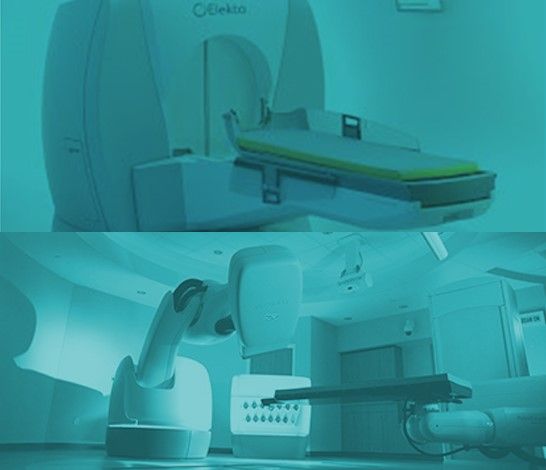
Radiosurgery is a non-incisional treatment that delivers a high, precisely focused dose of radiation to lesions in the brain — and in some cases elsewhere in the body — while sparing the surrounding healthy tissue.
What is radiosurgery?
Despite the word "surgery" in its name, radiosurgery is performed without an incision. Many beams of radiation are aimed from different directions so that they intersect at a single target: the target receives a high dose, while the healthy tissue each individual beam passes through receives only a small dose. The location and shape of the target and the critical structures around it are planned with millimetre accuracy using MRI, CT and, where needed, angiography.
Whereas conventional radiotherapy usually divides the dose into many sessions over several weeks, radiosurgery is completed in a single session or in a few sessions (usually no more than five). When it is delivered over several sessions it is called "hypofractionated radiosurgery".
Which systems are used?
- Gamma Knife: Focuses gamma rays from cobalt-60 sources onto a target inside the skull. It is used only for intracranial lesions and is known for its high precision.
- CyberKnife: Directs X-rays to the target using a linear accelerator mounted on a robotic arm. It can be used with a mask, is suitable for treatment over several sessions and can also treat lesions outside the head.
- Linear accelerator (LINAC)–based systems: Other radiotherapy machines adapted for radiosurgery.
The appropriate system and dose are chosen according to the type, size and location of the lesion, its distance from critical structures and the patient's general condition.
Which conditions can be treated?
- Brain metastases
- Benign tumors such as meningioma, vestibular schwannoma and pituitary adenoma
- Arteriovenous malformations (AVMs) and some cavernomas
- Residual or recurrent tumor after surgery
- Certain functional disorders such as trigeminal neuralgia
- Selected spinal and spinal cord tumors (with CyberKnife)
Treatment Approach
The decision for radiosurgery is made together with neurosurgery, radiation oncology and, where necessary, neuroradiology, based on the patient's imaging and clinical condition. In some conditions radiosurgery is used alone; in others it is combined with surgery or applied after surgery. In some cases open surgery or observation is the more appropriate option.
The effect of treatment usually develops over months rather than immediately, so patients are followed with regular MRI scans after treatment.

